Masking and Its Costs: What's Really Happening When Your Child "Holds It Together"
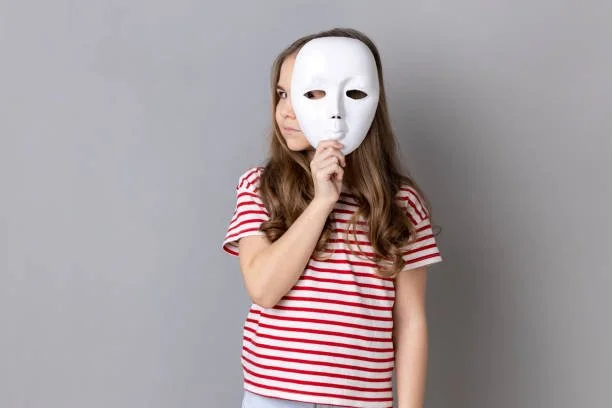
There's a version of your child that shows up at school, and a version that shows up at home.
If you've ever noticed the gap between them, you already know what this post is about. The kid who holds it together for six hours in a classroom, tracking every unspoken rule, and then falls apart the second the car door closes. The one who seems fine at a birthday party and then can barely speak for the rest of the evening.
Teachers sometimes describe this child as easygoing. Parents know better, because they're the ones who see what it actually takes to hold that together.
That gap has a name. It's called masking. Once you understand what it actually costs, a lot of confusing behavior stops being confusing.
What Masking Actually Is
Masking is the ongoing effort to suppress or hide traits that come naturally, and replace them with ones that are more socially expected, in order to avoid standing out, being corrected, or being excluded.
It can look like:
Forcing eye contact that feels uncomfortable
Rehearsing a phrase or a joke ahead of time so it comes out sounding natural
Suppressing a stim because someone once reacted badly to it
Copying another kid's tone or mannerisms almost like a script, because improvising from scratch feels too risky
None of this is conscious deception in the way the word "mask" might suggest. Most kids who do this couldn't tell you exactly when they started, or explain the rule they're following.
It's closer to something learned the way a hand learns to flinch away from a stove. Quietly, without much deliberation, because the alternative got uncomfortable enough times that the body found a workaround on its own.
Why Masking Develops in the First Place
Masking isn't a character flaw. It isn't a sign that something is wrong with a child's sense of self. It's a survival strategy, and like most survival strategies, it develops because it works, at least in the short term.
A kid who gets teased for stimming learns to stop stimming in public. A kid who gets corrected for talking too long about one topic learns to cut themselves off before anyone gets impatient. A kid who's told they're "too much" in some specific way learns to become less of that thing when other people are watching.
Every one of those adjustments buys something real: less teasing, fewer corrections, an easier ride through a school day.
The trouble is that what gets bought with masking isn't free. It's financed. And the bill comes due later, often somewhere the parent doesn't get to see directly.
What the Bill Actually Looks Like
Exhaustion. The most immediate cost, and a specific kind that's easy to underestimate from the outside. Holding a performance together for hours takes real effort, moment to moment, the way holding a plank position takes effort even though nothing about it looks dramatic from across the room. A child who's been masking all day isn't lazy or overreacting when they collapse the moment they're home.
Burnout. The longer version of the same problem. When masking becomes the default setting rather than an occasional strategy, kids can end up running a chronic deficit, the way a bank account slowly drains when withdrawals happen faster than deposits ever get made. This shows up as increased meltdowns, sudden regression in skills that used to come easily, flat affect, or exhaustion that a weekend off doesn't seem to fix anymore.
Losing track of self. The subtlest cost, and the hardest to spot because it doesn't look like a crisis. Kids who mask for long enough, starting young enough, can lose track of which parts of them are actually preference and which parts are performance. Ask an adult who masked heavily as a child what they truly enjoy, apart from what became socially safe to enjoy out loud, and some genuinely struggle to answer. The mask doesn't just hide the self from other people. Over enough years, it can start hiding the self from the person wearing it.
Why This Is Hard to Catch as a Parent
Masking is, by design, mostly invisible to the people it's meant to satisfy. A child who's good at it can look completely fine to a teacher, a coach, a relative, precisely because the performance is working.
Parents often catch only the aftermath: the meltdown after the smooth-sounding school day, without ever seeing the six hours of effort that led there. This can make it look like the collapse came out of nowhere, when really it was the entirely predictable result of something that had been building since morning.
It's also easy to unintentionally reward masking without realizing it. Praising a child for having "such a good day" at school, when a good day meant successfully suppressing every uncomfortable impulse for hours, quietly teaches that the performance is what's valued.
None of this happens because a parent wants their child to hide who they are. It happens because a masked performance and genuine ease look identical from the outside — there's no visible sign in the moment that one costs far more than the other.
What Helps, Without Asking a Child to Stop Entirely
I'm not sure there's a realistic version of childhood, or adulthood, that avoids adapting to different settings entirely. Most of us adjust some amount of ourselves depending on where we are, and that's probably always been true, neurodivergent or not. What feels different here isn't the adapting itself. It's when adapting quietly turns into disappearing — when a child stops adjusting how they communicate and starts erasing what's true underneath it just to get through the day.
We made it our mission to find as many environments as possible where we knew our son could thrive by just being himself. He's a born builder, and we'd drive to different states so he could attend the coolest weekend activities or classes. He's built out of recyclables, paper mache, metal, food, tree forts, blocks, you name it, and eventually moved on to MIG welding and armor.
The amazing thing about finding these unique environments that feed a child's passion is what happens next: your child thrives, their confidence soars, they meet their people, and you meet other parents on a similar journey, which teaches you a ton along the way.
Looking outside of school doesn't answer the day-to-day challenge of being in a classroom that may not be interesting, fair, or kind. We moved schools too, more than once, and never fully found the answer there. But the outside-of-school experiences taught our son something school couldn't: that we supported him and his interests genuinely. He discovered he was talented at a lot of things, and his confidence grew because of it. He met friends we could get together with on weekends so they could build side by side.
Finding the right environments was only half of it. The other half was giving him language to adapt honestly instead of silently. So that even in the rooms that weren't built for him, he had a way to say what he needed instead of performing his way through it. A child who can say what they need, in their own words, doesn't have to choose between performing and staying quiet.
That can sound like:
"Great question. I need a minute to buffer, think about it, and then respond."
"I heard you, I just process things a little slower, so give me a second."
"I'm listening, even though I'm not looking at you right now."
"Can we take a break? I'll come back and finish this in a few minutes."
"I'm not upset, this is just my normal voice when I'm excited about something."
None of these ask a child to hide anything. They ask the room to slow down for a second instead. That's a very different kind of adjustment than the one masking usually demands, and it's one a child can carry with them long after childhood, in classrooms, jobs, and relationships where nobody's told them the rules in advance.
A few other places to start:
Protect real recovery time after a demanding day, rather than filling it with more expectations the moment the car door closes.
Notice which environments require the most performance, and ask honestly whether anything about that environment could shift instead.
Pay attention to what your child does when nobody's correcting them, and treat that as real information about who they are, not a rough draft that still needs polishing.
The Takeaway
The environments where your child seems most themselves, unscripted and unrehearsed, aren't accidents. Neither are the ones where they seem most careful and controlled. The difference usually isn't about the people in the room being kinder or less kind. It's about how much translation your child feels they have to do to be accepted there.
You don't have to solve that everywhere at once. Finding even one more environment where the performance can drop, or giving your child one more phrase to say what they need out loud, is real progress.
About the author: Sylvia Hall is a parent to a neurodivergent child and co-founder of pebl connect. She writes from lived experience, alongside ongoing coursework and collaboration with research teams studying neurodivergent connection and communication.